

Nervous System Guide for Empathic Sensitivity
Our spiritual language talks a lot about “energy,” “downloads,” “awakening” and “alignment.” But underneath all of that, there is something very human and very physical quietly running the show: your nervous system.
If you’re an empath, highly sensitive, or moving through a spiritual awakening, you’ve probably noticed how quickly you can shift from peaceful to flooded, from open-hearted to shut-down. It can feel like too much—too much emotion, too much information, too much everything.
This isn’t a personal failing or a sign you’re “not spiritual enough.” It’s your nervous system doing exactly what it’s wired to do: protect you.
In this guide, we’ll look at how your nervous system and sensitivity actually work together, why awakening can intensify overwhelm, and how meditation, reiki, and yoga can help you regulate in a grounded, practical way—not as spiritual performance, but as genuine nervous system care.
---
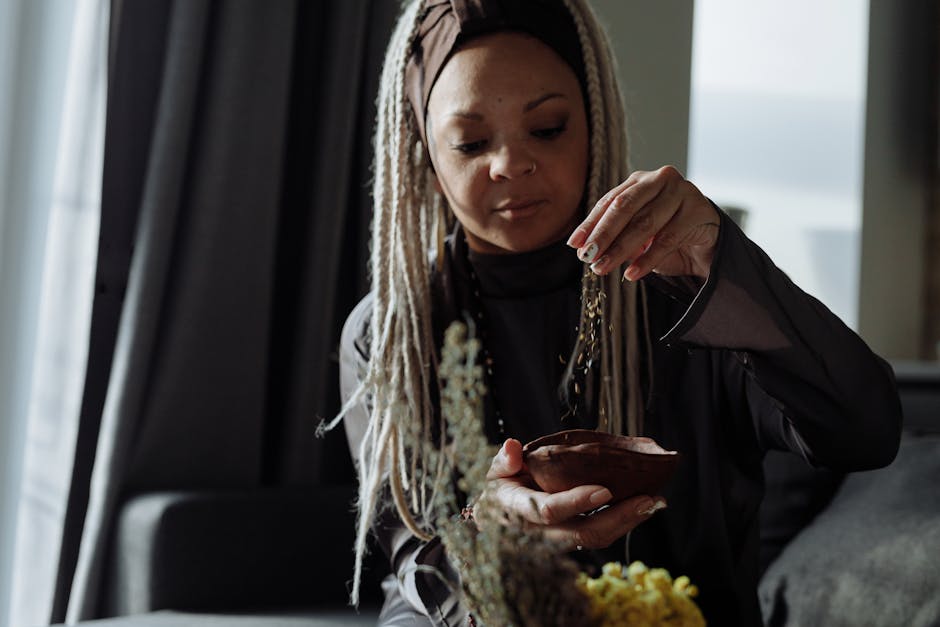
Photo by Thirdman on Pexels
Your Nervous System: The Invisible Background of Your Spiritual Life
Before we talk about practices, it helps to understand what we’re working with.
Your nervous system is your body’s communication network. It constantly scans your inner and outer world and decides:
- Am I safe?
For sensitive people and empaths, this system is often turned up to a higher volume. You notice more. You feel more. You process more.
The Three Main States (In Simple Language)
Very simply, your nervous system moves between three broad states:
1. Regulated / Safe Enough (Social Engagement) - You feel: present, connected, relatively grounded - Your body: breath is fuller, muscles softer, digestion works, you can think clearly - Spiritually: you feel open, intuitive, connected to guidance without losing yourself
2. Activated / Mobilized (Fight or Flight) - You feel: anxious, restless, irritated, on edge, hyper-focused or scattered - Your body: faster heart rate, shallow breath, tension in jaw/shoulders, urge to do something - Spiritually: urgency, “I have to fix this now,” racing thoughts about purpose or alignment
3. Shut Down / Numb (Freeze / Collapse) - You feel: exhausted, checked out, blank, hopeless, disconnected - Your body: heavy limbs, low energy, brain fog, difficulty moving or deciding - Spiritually: “I can’t feel my intuition,” “Everything feels pointless,” spiritual apathy
You will move between these states every day. This is normal. The goal is not to stay regulated forever. The goal is to recognize where you are and know how to support yourself there.
For empaths, the challenge is that your system may jump more quickly into activation or shutdown, especially in environments full of noise, conflict, or emotional intensity.
---
Why Spiritual Awakening Can Feel Overwhelming
If you’re in a spiritual awakening or deepening, you might notice:
This can be beautiful—and also deeply dysregulating.
Awakening Isn’t Just Light; It’s Voltage
Think of awakening as an increase in voltage running through your system. More awareness. More insight. More emotional honesty. More energy.
If your nervous system has been surviving on old patterns—people-pleasing, numbing, overworking, spiritual bypassing—this new voltage can feel like overload. The body says:
> “We’re changing everything? All at once? That sounds dangerous.”
So it responds with what it knows:
None of this means you’re “doing awakening wrong.” It means your body is asking to be included in the process.
---

Sensitivity and Empathic Gifts as Nervous System Realities
“Empath” and “highly sensitive” can sound mystical, but they’re also deeply physiological.
What’s Actually Happening When You “Absorb” Energy
When you walk into a room and immediately sense tension, sadness, or joy, a few things are happening:
If you were raised in an environment where you had to track others’ moods to stay safe—emotionally or physically—your sensitivity became a survival skill. Your nervous system learned:
> “If I feel everything, maybe I can prevent harm.”
As an adult (and especially on a spiritual path), that same skill can feel like a burden. You may:
Again, this isn’t a character flaw. It’s a brilliant nervous system adaptation that now needs new pathways.
---
Regulating vs. Suppressing: A Crucial Distinction
A lot of nervous system advice can accidentally turn into self-silencing:
Regulation isn’t about forcing yourself to be calm. It’s about creating enough internal safety to tell the truth about your experience.
This is where meditation, reiki, and yoga can be powerful—if they’re used as tools for presence, not escape.
---
Meditation for a Sensitive Nervous System
Meditation gets sold as a way to feel peaceful. For sensitive people, sitting still with your mind can sometimes do the opposite: it amplifies everything you’ve been avoiding.
So rather than forcing yourself into long, silent sits, you can adapt meditation to meet your nervous system.
1. Orienting Meditation (For Overwhelm & Anxiety)
Use when you feel scattered, panicky, or overstimulated.
1. Sit or lie down somewhere you feel reasonably safe. 2. Let your eyes land on one object in the room. Name it silently: “window,” “plant,” “candle.” 3. Slowly look around and name 5–10 things you see. No rush. 4. Feel the weight of your body supported by the chair, bed, or floor. 5. Place a hand on your chest or belly and notice the sensation of your palm on your body. 6. Say quietly (out loud or in your mind): - “Right now, in this moment, I am here.” - “There is a floor beneath me. There are walls around me. I am supported.”
This isn’t about transcending your body. It’s about arriving in it.
2. “Tiny Window” Meditation (For Highly Sensitive Days)
On days when your system feels raw, long practices can be too much. Try:
Short, consistent meditations like this widen your nervous system’s “window of tolerance” over time, without demanding more than it can give.
---

Photo by Lucas Pezeta on Pexels
Reiki and Energy Work for Nervous System Soothing
Reiki and other energy practices can feel especially supportive for empaths because they work with what you already sense: subtle shifts, warmth, tingling, emotional release.
How Reiki Can Support Regulation
Reiki doesn’t override your nervous system. It invites it to soften.
During or after a session (self or with a practitioner), people often report:
From a nervous system perspective, this can look like:
A Simple Self-Reiki-Inspired Practice
You don’t need formal training to begin working with your own energy:
1. Find a quiet space. Sit or lie down. 2. Rub your hands together for 10–15 seconds to generate warmth. 3. Place your hands gently: - Over your heart - Over your belly - Or one hand on heart, one on belly 4. Breathe slowly. On each exhale, imagine any tightness in your body softening by 1–2%. Not disappearing—just softening. 5. Stay for 5–10 minutes, or less if that’s all you have. 6. When you finish, thank your body: “Thank you for everything you hold. You don’t have to do it all alone.”
The point isn’t to achieve some perfect energy state. It’s to communicate safety and kindness to your system through touch and attention.
---
Yoga as Nervous System Recalibration (Not Performance)
Yoga can be incredibly regulating—or completely overwhelming—depending on how it’s approached.
For sensitive people, certain classes (loud music, fast flows, intense heat) may actually push your nervous system into more activation, even if everyone around you seems “energized.”
Choosing Yoga that Honors Sensitivity
Look for classes or home practices described as:
These often include:
A Short Grounding Yoga Sequence
Use this to downshift after a stimulating day:
1. Child’s Pose - Kneel on the floor, fold forward, arms extended or by your sides - Rest your forehead on the mat or a cushion - Breathe into your back body for 10–20 breaths
2. Supine Twist - Lie on your back, knees bent - Let both knees fall to one side, arms open in a T or cactus shape - Turn your head in the opposite direction if comfortable - Stay for 5–10 breaths each side
3. Legs Up the Wall - Sit sideways next to a wall, then lie back as you swing your legs up the wall - Place a folded blanket under your hips if desired - Rest your arms wherever they feel comfortable - Stay for 5–15 minutes, or as long as feels good
Throughout, keep asking: > “Does this feel supportive to my nervous system right now?” If not, adjust or stop. Your body’s feedback is the real teacher.
---

Photo by Miriam Alonso on Pexels
Practical Daily Support for Empaths and Sensitive Systems
Spiritual practice doesn’t have to be elaborate to be effective. For a sensitive nervous system, small, consistent choices are more powerful than occasional dramatic shifts.
1. Create a “Nervous System Corner”
Designate a small area in your home as a landing place when you feel overwhelmed:
Train your body: “When I come here, I’m allowed to slow down.”
2. Set Clear Energy & Time Boundaries
Your nervous system needs predictable breaks from stimulation:
🔮 You might also enjoy: [What Shadow Work Actually Looks Like](https://sassysoul.shop/blogs/news/what-shadow-work-actually-looks-like-1)
Boundaries are not rejection. They are regulation tools.
3. Track Your Personal Triggers and Supports
Over a week or two, notice:
Examples might include:
Your list will be unique. Let it evolve.
---
When Overwhelm Feels Like Too Much
Sometimes, even with practices, the nervous system can feel unbearable. If you notice:
This is not a sign that you’re “failing” at being spiritual or sensitive. It’s a sign your system might need more support than you can or should give alone.
Trauma-informed therapists, somatic practitioners, or experienced energy workers can help you move through what’s arising at a pace that doesn’t re-traumatize your body.
Seeking support is not abandoning your spiritual path. It is deep alignment with it.
---
Letting Your Nervous System Lead Your Awakening
Spiritual awakening often gets framed as leaving the body, transcending the human mess, and reaching for something higher.
But for sensitive people, the real initiation is usually the opposite:
You don’t have to choose between your sensitivity and your stability. They can coexist.
Your nervous system is not blocking your awakening. It is the vessel that will carry it.
If you move at the pace of your body—one breath, one boundary, one small practice at a time—awakening becomes less like a storm tearing through you and more like a tide: powerful, yes, but rhythmic, trustworthy, and ultimately, deeply kind.


